
Mary Ellen Iskenderian
Mary Ellen Iskenderian on Driving Gender Equality in the Financial System
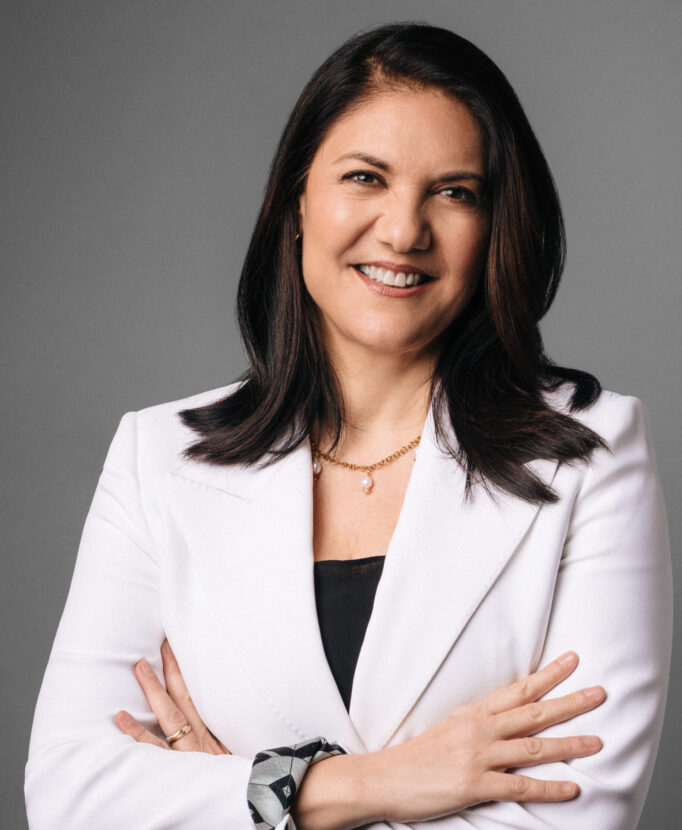
Keynote Speaker
President and CEO, Women’s World Banking; Author of There’s Nothing Micro About a Billion Women: Making Finance Work for Women
Mary Ellen Iskenderian is a globally recognized authority on women's economic opportunity, a leading voice on how AI, financial systems, and capital markets can either widen or close the gender gap. She shows audiences the $700 billion the financial sector is leaving on the table — and why closing that gap is one of the largest untapped opportunities in modern finance.
Mary Ellen Iskenderian's speaking fee: Under $25,000
Mary Ellen Iskenderian is President and CEO of Women’s World Banking, the global nonprofit dedicated to advancing economic opportunity for women by expanding their ability to earn more, make financial decisions, and protect their livelihoods in the face of climate and health risks. This
work operates on both a microeconomic and macroeconomic level — strengthening individual women’s businesses while shaping the financial systems, institutions, and policies that drive broader economic growth.
Mary Ellen leads the organization’s dual approach to driving systemic change — partnering with financial institutions and policymakers to design solutions that address market failures, and investing directly as an equity partner to build enterprise value and generate financial returns. Through this model, Women’s World Banking works to unlock business and economic growth opportunities by building financial systems that reflect how women actually live, work, and manage risk.
Over the past eight years, Women’s World Banking has reached 118 million women and 76 million men with solutions and programs that drive income generation, job creation, and sustainable economic security. Building on that scale, the organization is now advancing toward deeper, measurable outcomes — pairing skills, capital, markets, protection, and technology into financial systems built around women’s real economic lives.
Mary Ellen Iskenderian is one of the leading voices making the economic case for inclusion, empowerment, and opportunity. She challenges institutions to move beyond viewing women as a niche segment and to recognize them instead as a powerful opportunity, yet underserved market. Her work examines how better-designed financial systems — grounded in data, product innovation, and policy — expand women’s participation in the economy, driving job creation, enterprise growth, and stronger financial performance.
Mary Ellen is the author of There’s Nothing Micro About a Billion Women: Making Finance Work for Women, published by MIT Press in 2022.
Mary Ellen is a permanent member of the Council on Foreign Relations, serves as a Director on the Board of the William and Flora Hewlett Foundation, and is a member of the World Economic Forum’s Global Future Council, the UAE Central Bank’s Financial Inclusion and Literacy Working Group, and the CNBC Global Financial Wellness Advisory Board.
Meet Mary Ellen Iskenderian
Mary Ellen Iskenderian on Creating Products for Women
Mary Ellen Iskenderian on the Drivers of Women Into the Financial System
Mary Ellen Iskenderian on Financial Barriers
Mary Ellen Iskenderian on Scaling and Inclusion
Mary Ellen Iskenderian on Driving Gender Equality in the Financial System
Mary Ellen Iskenderian on Driving Gender Equality in the Financial System
Women are often on the front lines of climate and health shocks, yet more than 800 million still lack access to the financial tools needed to receive emergency relief payments. As extreme weather, disease, and environmental pressures increase, so do disruptions to income, rising healthcare costs, and financial vulnerability. More than 60% of women-led MSMEs have already been affected by climate change and over 15% are likely to face business failure due to a natural disaster in the next three years. Without action, climate change could push up to 158 million more women and girls into poverty by 2050.
Mary Ellen draws on evidence and examples from around the world, examining how financial services help women earn more, make decisions about their finances and healthcare, and protect their livelihoods when crises occur. Access to savings, insurance, credit, and digital payments can determine whether a woman is able to keep her business running, invest in adaptation measures, manage healthcare expenses, recover from shocks, and maintain financial stability over time.
Women are already adapting, managing risk, and leading recovery efforts in their households, businesses, and communities. Financial systems that recognize and support these realities can strengthen resilience, accelerate climate adaptation, improve health outcomes, and expand economic opportunity at scale.
Artificial intelligence doesn’t create bias — it inherits it, hardens it, and scales it in seconds. Every algorithm making decisions about credit, fraud, and financial risk today was trained on decades of data shaped by a system that routinely left women out. Left unchecked, AI doesn’t just repeat that exclusion — it automates it, and multiplies it across millions of decisions before anyone notices.
The numbers reveal why this moment is so urgent. Women hold roughly 16% of AI research roles globally, meaning the systems shaping the future of finance are overwhelmingly built without women’s realities at the table. The result: studies show nearly half of AI systems assessed demonstrate measurable gender bias, embedded in the very credit scores, fraud filters, and onboarding tools that determine who gets seen — and who gets shut out.
This isn’t just a fairness problem. It’s a massive, self-inflicted financial blind spot. Women’s World Banking’s own research has found that women are frequently better credit risks — stronger repayers, more consistent, lower default rates — yet AI-driven credit scoring systems routinely miscalculate their risk and deny them equal access to capital. That miscalibration isn’t a rounding error; it’s an estimated $17 billion in gender credit gap that financial institutions are leaving on the table, every year, because their models can’t see women accurately.
Mary Ellen makes the case that this window is closing fast: as AI gets baked deeper into financial infrastructure, bias doesn’t stay static — it compounds, and it becomes exponentially harder to unwind once it’s operating at scale. She lays out what it will take to reverse course: gender-disaggregated data, women-centered design, and accountability built in before — not after — bias becomes permanent. Done right, AI can finally make women visible to the financial system in ways decades of policy couldn’t. Done wrong, it will lock in the same discrimination at a scale and speed the industry has never seen before.
We are living through the largest transfer of wealth in history — $68 trillion moving between generations by 2030, with women positioned to inherit and control a significant share of it, as spouses, heirs, and stewards of family wealth.
The stakes go far beyond who keeps which client. The World Economic Forum estimates that $3.22 trillion in additional investment capital could be unlocked globally if women invested at the same rate as men. That means the wealth transfer isn’t just a moment of risk for financial institutions — it’s a closing window of opportunity. As trillions move into women’s hands, firms that fail to engage them as serious investors won’t just risk losing assets to competitors; they’ll leave trillions in capital sitting idle in cash and low-yield accounts instead of being put to work in portfolios, markets, and products they could be managing.
Yet financial systems have not caught up. Women continue to be treated as a niche segment, despite being disciplined, engaged investors — making an average of 26 lifetime referrals compared to 11 from men, and consistently earning stronger net returns due to more measured, less reactive trading behavior.
Mary Ellen frames this as a financial system design challenge: Institutions that don’t adapt won’t just face client churn as assets move to providers that better reflect women’s needs — they’ll miss the chance to responsibly deploy trillions in capital that could fuel growth for women and the broader economy alike.
She highlights three priorities:
This shift is already underway. Institutions that move early won’t just protect assets under management — they’ll help unlock one of the largest untapped pools of investment capital in the global economy.
The financial services industry is sitting on a $700 billion problem — the annual revenue opportunity left on the table by failing to serve women and men at parity. It isn’t marginal. It’s one of the largest overlooked opportunities in modern finance.
Access has improved — 73% of women in low- and middle-income economies now hold a financial account, closing the gender gap to just five points. But access was never the whole problem. Products are still built around a default customer who doesn’t carry the unpaid care work, income volatility, and asset constraints that shape most women’s financial lives — and most institutions don’t even track performance by gender, leaving billions in missed opportunity invisible on the balance sheet.
Mary Ellen Iskenderian shows financial institutions exactly where the leaks are: in product design, capital allocation, and policy that quietly determines whether access ever becomes income, assets, or growth. The institutions that close this gap first won’t just do right by women — they’ll capture a $700 billion market everyone else is still leaving behind.
Tell us about your event and the speaker you are interested in booking and we will be in touch right away.