Celeb Shot
Your Workplace is Your Laboratory
Former NASA Astronaut, Mike Massimino, shares lessons on innovative problem solving.
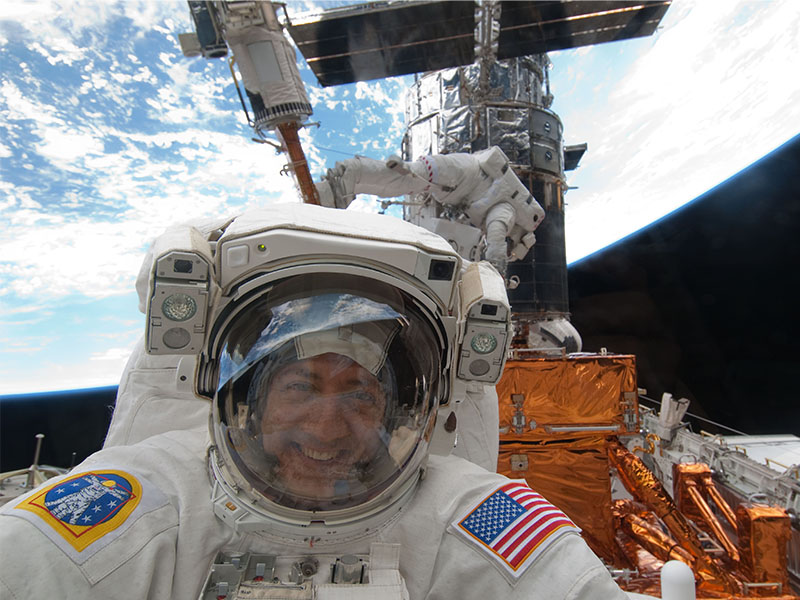
To innovate, you need a space to experiment and try out new ideas. Thinking of your workplace as a “lab” for you and your team to test out new ideas – without fear of failure – can help to create new efficiencies and effective processes. Test out new ideas and get feedback from colleagues on which innovations will “move the needle.”
In 1996, when I reported to the NASA Johnson Space Center as a new astronaut, there was a lot of buzz about a new underwater spacewalking training facility – the Neutral Buoyancy Laboratory or NBL. The NBL had enough room for full-scale mockups of the Space Shuttle, the Hubble Space Telescope, and the International Space Station. It was huge. Measuring 100 feet wide by 200 feet long by 40 feet deep, it is the largest pool in the world.
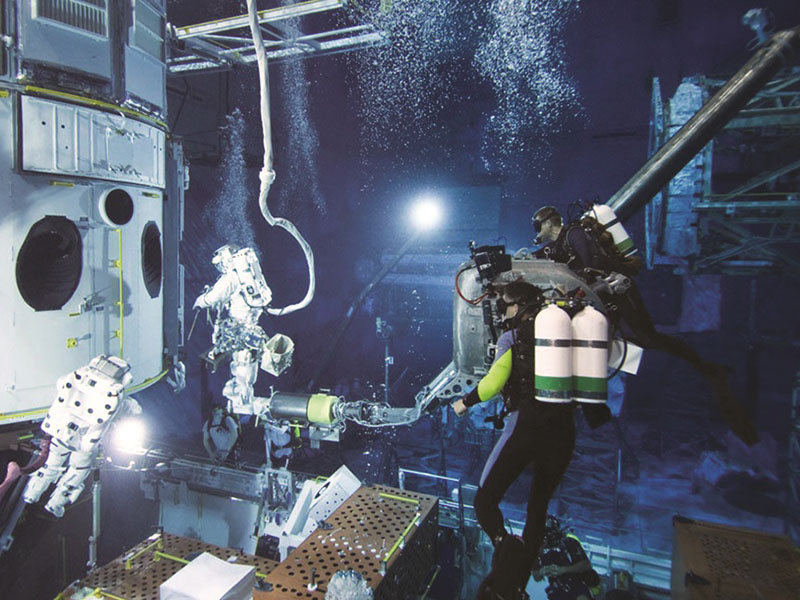
Upon learning its name, I was a bit confused as to why it would be called a laboratory. I thought perhaps “Gigantic Pool” would be a more accurate name for the facility. Laboratories, I thought, were filled with scientific equipment, computers, and lab coats. After a few years I began to understand. It was a laboratory because we could try new ideas, experiment with new tools and techniques, and use innovative problem solving to develop our spacewalk procedures.
It was also a workplace where everyone had a voice. During my spacewalk training we had a standing challenge from our management. If an engineer or astronaut could figure out a way to save even one minute of spacewalking time, they would be given special recognition. Not cash – this was after all a government operation – but the admiration of your teammates. All ideas were welcome. Even if the idea was not implemented, leadership would explain why and thank the individual for the idea. This was especially important for people who were new to NASA. Often the new person has a fresh idea and perspective and needs to bring that to the team. This only works if leadership fosters a culture that encourages people to speak up, and that motivates everyone to listen when suggestions are made even if they seem a bit out of the ordinary. A negative reaction from leadership could discourage team members from speaking up in the future and crush creativity. This laboratory culture at NASA enabled us to develop solutions that solved our most challenging problems.
My first spaceflight was a mission to the Hubble Space Telescope, and I was the only rookie out of the four spacewalkers on our crew. To say I was a bit intimidated was an understatement. The major science objective for the mission was the installation of the Advanced Camera for Surveys (ACS). The ACS was about the size of a large refrigerator. Installation required that ACS perfectly aligned with a latch inside the Hubble. However, getting perfect alignment proved to be quite tricky on previous missions. The latch was out of sight, near the back end, and below the instrument. The accepted method was trial and error. Astronauts would try to engage the latch, and if the instrument jammed the astronauts would realign and keep trying until it worked. It typically took several tries to correctly align and successfully engage the latch during each of our training sessions in the NBL. It was frustrating and time consuming. “There has to be a better way to do this,” I thought.
The issue was that we could not directly see the latch alignment at the back of ACS. But I started to think about what I could see. I could see the front of the instrument and the end of the guide rail that ACS would slide upon. We knew the exact dimensions of the instrument and of the guide rail. If we could use the alignment of the front of the instrument with the front of the guide rail when the instrument was in the correct position, then we would know that the back of the instrument was aligned. I proposed that we develop an alignment aid to help align the instrument in the front to make sure it was aligned correctly at the back. My crewmates and our engineers decided it was worth a try.
Our engineers designed the new alignment tool, and we tried it in the NBL. It worked like a charm. A flight version was made and used to install ACS into Hubble during the flight. In space, the new tool saved us time by helping us to install the ACS on the first attempt. The time savings allowed us to perform some extra tasks that extended the life of the telescope.
After our mission, the ACS went on to capture one of the deepest optical images of the universe ever taken, the Hubble Ultra Deep Field. It provided a 3-dimensional view of the universe and allowed astronomers to look back in time. Looking back nearly 13 billion years into history in a single image, an astonishing achievement. It also confirmed the discovery of “Dark Energy,” an unseen force that is accelerating the expansion of the universe. This discovery was awarded the Nobel Prize in Physics in 2011 to three astronomers, including Dr. Adam Reiss of the Hubble Space Telescope Science Institute, using Hubble/ACS data. I was honored to play a small role in this discovery by installing the instrument that would make it possible.
I was grateful that my team was willing to listen to my idea even though I was the new person on a team of not only experienced astronauts, but also engineers who had been working on similar tasks for many years over 3 previous Hubble servicing missions. After my first mission I knew when the time came for me to be a leader on a spaceflight, I would always listen to the ideas of the rookie space flyers even if they were commenting on a task that had been completed using an accepted method on previous missions. Sometimes a fresh perspective can be the best perspective, and a needed one. We had the perfect place to experiment with new ideas, our laboratory, the NBL. I encourage audiences during my speaking events to adopt this culture and treat their workplace as a laboratory, where everyone has a voice and innovations can be developed to solve their most challenging problems.
Events aren’t easy, but working with WSB is. WSB works with thousands of respected influencers, thought leaders, and speakers each year and our experienced sales team is committed to the success of your event. For more astronaut speaker ideas, please contact us.